Pure Diffuser Lab Reports & Product Documentation

Pure Diffuser · Transparency

Laboratory Reports & Product Documentation

This page provides available laboratory documentation associated with Pure Diffuser and Pure Mate™ products. Reports should be read according to the specific sample, product, batch, testing method and reporting limits shown on the original document.

Laboratory Documentation Product-Specific Results Report Scope Matters
Read the
Report
Not Just the Badge
A laboratory report applies to the sample and scope identified in that report.

A result such as “not detected” does not mean that every possible substance was tested, nor should an individual report be interpreted as a guarantee that vapor inhalation is risk-free.

Available Documentation

Laboratory Report Library

The report images below are provided for transparency. For exact results, units, reporting limits, sample identifiers and test methods, refer to the original laboratory document.

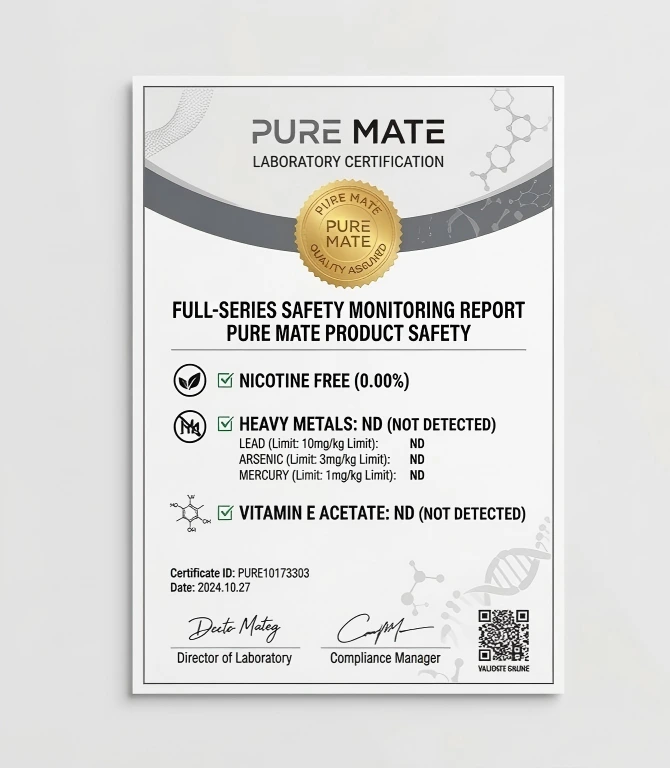
Pure Diffuser laboratory analytical report
Analytical Documentation

Screening & Analytical Report

Review the original document for the exact sample information, analytical targets, reporting limits and laboratory findings.

  • Sample See report document
  • Test Date See report document
  • Testing Laboratory See report document
  • Analytes Refer to the substances listed on the report
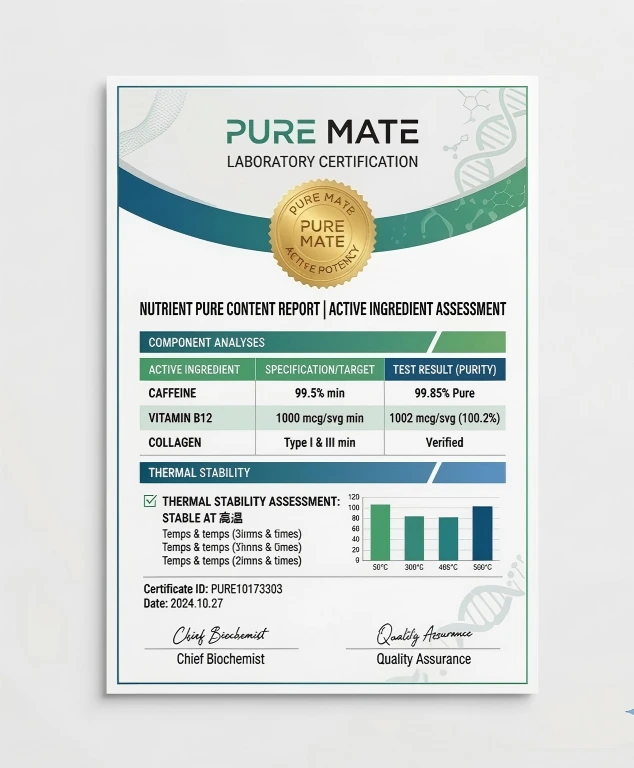
Pure Diffuser product composition laboratory report
Product Documentation

Composition & Analytical Report

This document should be interpreted according to the analytical methods, sample details and measured results reported by the laboratory.

  • Product / Sample See report document
  • Method See report document
  • Measured Components Refer to the report
  • Reported Results Use the values and units shown on the document
Why aren't we rewriting every result into marketing language?

Laboratory findings are most useful when customers can review the actual document, including its units, reporting limits and sample identification. Summaries should not extend beyond what the report itself establishes.

Report Basics

How to Read a Laboratory Report

01 · Sample

Sample Identification

Check which product, formulation or batch the laboratory actually received.

02 · Method

Analytical Method

Reports may use different analytical methods depending on the substance being measured.

03 · Result

Units & Reporting Limits

A numerical result or “not detected” statement should be read together with its unit and detection/reporting limit.

Testing Terminology

What Common Laboratory Terms Mean

Term General Meaning Important Limitation
Not Detected / ND The laboratory did not detect the analyte above the applicable reporting or detection limit. It does not necessarily mean absolute zero.
GC-MS Gas chromatography–mass spectrometry, an analytical technique used for certain chemical compounds. It does not test every possible substance automatically.
ICP-MS Inductively coupled plasma mass spectrometry, commonly used to measure elemental concentrations. Results apply to the elements and sample actually tested.
HPLC High-performance liquid chromatography, used for certain composition or concentration analyses. Measuring a compound does not by itself establish human absorption or physiological effects.
Accredited Laboratory A laboratory may hold accreditation for specified methods or scopes. Accreditation should be verified from the actual laboratory and scope shown on the report.
Transparency

What Laboratory Testing Can — and Cannot — Tell You

Can Show

Measured Results

A report can show results for the specific analytes, methods and sample identified by the laboratory.

Can Show

Sample Information

The report can identify the submitted sample, dates and testing laboratory.

Cannot Establish

Zero-Risk Inhalation

A laboratory report should not be interpreted as proof that inhaling vapor or aerosol is completely risk-free.

Frequently Asked Questions

Lab Report FAQ

Does a lab report prove that a product is completely safe?
No. A laboratory report provides results for the specific tests and sample described in that report. It should not be interpreted as a guarantee of complete or zero-risk inhalation safety.
What does “not detected” mean?
It generally means the laboratory did not detect the substance above the applicable detection or reporting limit. Refer to the original report for the exact limit.
Does one report apply to every Pure Diffuser product?
Not automatically. The scope of each document depends on the sample, product, batch and testing information shown on that report.
Does detecting B12 or caffeine prove absorption?
No. Analytical confirmation of a compound in a product does not by itself establish human absorption, bioavailability or a physiological outcome.
Where should I check the exact laboratory result?
Use the original report document. Check the sample name, test date, laboratory, analytical method, result, unit and reporting limit.
Pure Diffuser Transparency Product Documentation Matters

Review available laboratory documentation together with current product specifications and labeling.

Explore Pure Diffuser →